Gigalo Joe What Do You Know Ai
| A.I. Artificial Intelligence | |
|---|---|
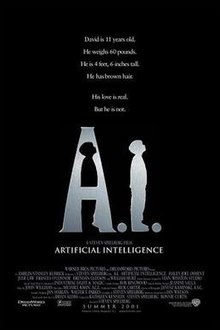 Theatrical release affiche | |
| Directed past | Steven Spielberg |
| Screenplay by | Steven Spielberg |
| Screen story by | Ian Watson |
| Based on | "Supertoys Last All Summer Long" by Brian Aldiss |
| Produced past |
|
| Starring |
|
| Cinematography | Janusz Kamiński |
| Edited by | Michael Kahn |
| Music past | John Williams |
| Production |
|
| Distributed by |
|
| Release date |
|
| Running time | 146 minutes[1] |
| Country | United states |
| Language | English |
| Budget | $90–100 million[two] [3] |
| Box part | $235.9 million[3] |
A.I. Artificial Intelligence (also known as A.I. ) is a 2001 American science fiction drama motion picture directed by Steven Spielberg. The screenplay past Spielberg and screen story past Ian Watson were based on the 1969 short story "Supertoys Last All Summer Long" by Brian Aldiss. The film was produced by Kathleen Kennedy, Spielberg and Bonnie Curtis. Information technology stars Haley Joel Osment, Jude Law, Frances O'Connor, Brendan Gleeson and William Hurt. Prepare in a futuristic postal service-climatic change society, A.I. tells the story of David (Osment), a artless android uniquely programmed with the ability to honey.
Development of A.I. originally began with producer-managing director Stanley Kubrick, subsequently he acquired the rights to Aldiss' story in the early 1970s. Kubrick hired a serial of writers until the mid-1990s, including Brian Aldiss, Bob Shaw, Ian Watson, and Sara Maitland. The film languished in evolution hell for years, partly because Kubrick felt computer-generated imagery was not advanced plenty to create the David character, whom he believed no child actor would assuredly portray. In 1995, Kubrick handed A.I. to Spielberg, but the film did not gain momentum until Kubrick's death in 1999. Spielberg remained close to Watson'southward film handling for the screenplay.
A.I. Bogus Intelligence was released in North America on June 29, 2001, by Warner Bros. Pictures and internationally by DreamWorks Pictures. The film received generally positive reviews from critics and grossed approximately $235 million against a budget of $90–100 million. It was nominated for All-time Visual Effects and Best Original Score at the 74th Academy Awards. In a 2016 BBC poll of 177 critics around the world, A.I. Bogus Intelligence was voted the lxxx-third-greatest film since 2000.[four] A.I. is defended to Kubrick.
Plot [edit]
In the 22nd century, rising sea levels from global warming accept wiped out coastal cities, reducing the world's population. Mecha humanoid robots seemingly capable of complex thought but lacking in emotions, accept been created.
In Madison, New Jersey, David, a prototype Mecha child capable of experiencing beloved, is given to Henry Swinton and his wife Monica, whose son Martin contracted a rare affliction and has been placed in suspended blitheness. Monica initially feels uneasy with David, but somewhen warms to him and activates his imprinting protocol, causing him to take an enduring, childlike love for her. David seeks to have Monica express the same love towards him, and also befriends Teddy, Martin's robotic teddy behave. Martin is unexpectedly cured of his disease and brought home. Martin becomes jealous of David and goads him to perform worrisome acts, such as cutting off the locks of Monica's hair while she is sleeping. At a pool political party, i of Martin's friends pokes David with a knife, triggering his self-protection programming. David grabs onto Martin, and they both fall to the bottom of the pool, with David holding Martin tightly. Others leap in and salve Martin before he drowns, and David is accused of existence a danger to living people. Henry convinces Monica to return David to his creators to exist destroyed, thinking that if David tin love, he also tin can hate. On the style there, Monica has a change of heart and spares David from devastation by leaving him in the woods. With Teddy as his only companion, David recalls The Adventures of Pinocchio and decides to notice the Bluish Fairy so that she may plough him into a real boy, which he believes will win back Monica's love.
David and Teddy are captured past a "Flesh Fair", a traveling circus-like event where obsolete Mecha are destroyed before jeering crowds who hate Mecha, assertive them to be both dangerous and a crusade of human unemployment. About to exist destroyed himself, David pleads for his life, and the audition, deceived by David'southward realistic nature, revolts and allows David to escape alongside Gigolo Joe, a male prostitute Mecha on the run from government after being framed for murder. David, Teddy, and Joe go to the decadent resort town of Rouge City, where "Dr. Know", a holographic respond engine, directs them to the top of Rockefeller Middle in the flooded ruins of Manhattan and also provides fairy tale information interpreted past David as suggesting that a Blue Fairy has the power to assist him. Above the ruins of Manhattan, David meets Professor Hobby, his creator, who tells him that their coming together demonstrates David's ability to love and desire. David finds many copies of himself, including female variants called "Darlene", boxed and fix to be shipped. Disheartened past his lost sense of individuality, David attempts suicide by falling from a skyscraper into the ocean. While underwater, David catches sight of a figure resembling the Blue Fairy before Joe rescues him in an amphibious aircraft. Before David can explain, Joe is captured via electromagnet past authorities. David and Teddy take control of the aircraft to see the Fairy, which turns out to exist a statue from an attraction on Coney Isle. The two become trapped when the Wonder Wheel falls on their vehicle. Believing the Blue Fairy to exist real, David asks the statue to turn him into a existent boy and repeats this request until his internal power source is depleted.
Two thousand years afterwards, humanity has get extinct and Manhattan is at present cached under glacial ice. The Mecha have evolved into an advanced form, and a group of them called the Specialists have get interested in learning nearly humanity. They find and revive David and Teddy. David walks to the frozen Blue Fairy statue, which collapses when he touches it. The Specialists reconstruct the Swinton family habitation from David's memories and explicate to him, via an interactive image of the Blue Fairy, that it is impossible to brand David a existent boy. Nonetheless, at David's insistence, they utilize their scientific knowledge to recreate Monica through genetic material from the strand of pilus that Teddy kept. This Monica can live for merely one day, and the process cannot exist repeated. David spends his happiest day with Monica, and as she falls asleep in the evening, she tells David that she has always loved him: "the everlasting moment he had been waiting for", the narrator says; "David falls comatose likewise and goes to that place 'where dreams are born.'"
Cast [edit]
- Haley Joel Osment equally David. Osment was Spielberg's first and but choice for the role. To portray the grapheme, Osment avoided blinking his eyes and "programmed" himself with good posture.[5]
- Frances O'Connor equally Monica Swinton
- Sam Robards as Henry Swinton
- Jude Law equally Gigolo Joe. To prepare for the role, Law studied the acting of Fred Astaire and Gene Kelly, whose movements Joe emulates.[half dozen]
- Jake Thomas as Martin Swinton
- William Hurt equally Professor Allen Hobby
- Brendan Gleeson as Flesh Fair impresario Lord Johnson-Johnson
- Jack Angel equally Teddy (voice)
- Ken Leung, Matt Winston, Eugene Osment and Clark Gregg as Cybertronics Corp employees
- April Grace as Female Colleague
- Enrico Colantoni as The Murderer
- Paula Malcomson as Patricia in Mirrored Room
- Ashley Scott as Gigolo Jane
- Kathryn Morris every bit Teenage Honey
- Adrian Grenier as Teen in Van
- Robin Williams as Dr. Know (vocalisation)
- Ben Kingsley equally Specialist (vocalization)
- Meryl Streep equally the Bluish Fairy (voice)
- Chris Rock equally Comedian Robot (vocalisation)
- Erik Bauersfeld equally Gardener (voice)
- Ministry as Flesh Fair band
Production [edit]
Development [edit]
Kubrick began development on an accommodation of "Super-Toys Last All Summer Long" in the late 1970s, hiring the story's author, Brian Aldiss, to write a film handling. In 1985, Kubrick asked Steven Spielberg to direct the moving-picture show, with Kubrick producing.[vii] Warner Bros. agreed to co-finance A.I. and cover distribution duties.[8] The film labored in development hell, and Aldiss was fired by Kubrick over creative differences in 1989.[9] Bob Shaw briefly served as writer, leaving after six weeks due to Kubrick'due south demanding work schedule, and Ian Watson was hired as the new writer in March 1990. Aldiss afterwards remarked, "Not but did the bastard fire me, he hired my enemy [Watson] instead." Kubrick handed Watson The Adventures of Pinocchio for inspiration, calling A.I. "a picaresque robot version of Pinocchio".[8] [ten] [11]
Iii weeks afterward, Watson gave Kubrick his first story treatment, and ended his work on A.I. in May 1991 with another treatment of ninety pages. Gigolo Joe was originally conceived as a M.I. Mecha, but Watson suggested changing him to a male prostitute. Kubrick joked, "I guess we lost the kiddie market."[eight] Meanwhile, Kubrick dropped A.I. to work on a moving picture adaptation of Wartime Lies, feeling figurer animation was not advanced plenty to create the David character. Afterwards the release of Spielberg'due south Jurassic Park, with its innovative calculator-generated imagery, it was appear in Nov 1993 that product of A.I. would brainstorm in 1994.[12] Dennis Muren and Ned Gorman, who worked on Jurassic Park, became visual effects supervisors,[9] simply Kubrick was displeased with their previsualization, and with the expense of hiring Industrial Light & Magic.[thirteen]
"Stanley [Kubrick] showed Steven [Spielberg] 650 drawings which he had, and the script and the story, everything. Stanley said, 'Await, why don't you lot direct information technology and I'll produce it.' Steven was nearly in daze."
– Producer Jan Harlan, on Spielberg's first meeting with Kubrick about A.I. [xiv]
Pre-product [edit]
In early 1994, the film was in pre-production with Christopher "Fangorn" Baker as concept creative person, and Sara Maitland profitable on the story, which gave it "a feminist fairy-tale focus".[viii] Maitland said that Kubrick never referred to the film as A.I., but equally Pinocchio.[13] Chris Cunningham became the new visual effects supervisor. Some of his unproduced work for A.I. can be seen on the DVD, The Piece of work of Managing director Chris Cunningham.[15] Aside from considering estimator animation, Kubrick too had Joseph Mazzello do a screen test for the atomic number 82 part.[13] Cunningham helped get together a series of "little robot-blazon humans" for the David graphic symbol. "We tried to construct a little boy with a movable safe face to meet whether we could make it look appealing," producer Jan Harlan reflected. "But it was a full failure, it looked atrocious." Hans Moravec was brought in every bit a technical consultant.[13] Meanwhile, Kubrick and Harlan thought A.I. would be closer to Steven Spielberg's sensibilities as director.[sixteen] [17] Kubrick handed the position to Spielberg in 1995, but Spielberg chose to direct other projects, and convinced Kubrick to remain as director.[14] [18] The film was put on hold due to Kubrick's commitment to Eyes Wide Shut (1999).[19]
After Kubrick'southward death in March 1999, Harlan and Christiane Kubrick approached Spielberg to take over the director's position.[20] [21] By November 1999, Spielberg was writing the screenplay based on Watson'south xc-page story handling. It was his beginning solo screenplay credit since Close Encounters of the Tertiary Kind (1977).[22] Spielberg remained close to Watson's treatment, simply removed various sex scenes with Gigolo Joe.[ citation needed ] Pre-production was briefly halted during February 2000, because Spielberg pondered directing other projects, which were Harry Potter and the Philosopher's Stone, Minority Report, and Memoirs of a Geisha.[19] [23] The post-obit month Spielberg announced that A.I. would exist his next project, with Minority Study equally a follow-up.[24] When he decided to fast track A.I., Spielberg brought Chris Bakery back as concept artist.[18] Ian Watson reported that the terminal script was very faithful to Kubrick's vision, even the ending, which is oftentimes attributed to Spielberg, saying, "The final 20 minutes are pretty close to what I wrote for Stanley, and what Stanley wanted, faithfully filmed by Spielberg without added schmaltz."[25]
Filming [edit]
The original first date was July 10, 2000,[17] but filming was delayed until August.[26] Aside from a couple of weeks shooting on location in Oxbow Regional Park in Oregon, A.I. was shot entirely using sound stages at Warner Bros. Studios and the Spruce Goose Dome in Long Embankment, California.[27] Spielberg copied Kubrick's obsessively secretive approach to filmmaking by refusing to give the complete script to cast and crew, banning press from the set, and making actors sign confidentiality agreements. Social robotics expert Cynthia Breazeal served as technical consultant during production.[17] [28] Costume designer Bob Ringwood studied pedestrians on the Las Vegas Strip for his influence on the Rouge City extras.[29]
Casting [edit]
Julianne Moore and Gwyneth Paltrow were considered for the role of Monica Swinton before Frances O'Connor was bandage and Jerry Seinfeld was originally considered to voice and play the Comedian Robot before Chris Rock was bandage.[xxx]
Soundtrack [edit]
The movie'southward soundtrack was released by Warner Dusk Records in 2001. The original score was equanimous and conducted by John Williams and featured singers Lara Fabian on two songs and Josh Groban on one. The flick's score as well had a express release as an official "For your consideration Academy Promo", likewise as a complete score issue by La-La Land Records in 2015.[31] The ring Ministry appears in the film playing the song "What Most Us?" (but the song does non appear on the official soundtrack anthology).
Release [edit]
Marketing [edit]
Warner Bros. used an alternate reality game titled The Beast to promote the film. Over forty websites were created past Atomic Pictures in New York City (kept online at Cloudmakers.org) including the website for Cybertronics Corp. There were to exist a serial of video games for the Xbox video game panel that followed the storyline of The Beast, but they went undeveloped. To avoid audiences mistaking A.I. for a family unit film, no activity figures were created, although Hasbro released a talking Teddy following the picture'due south release in June 2001.[17]
A.I. premiered at the Venice Moving-picture show Festival in 2001.[32]
Dwelling media [edit]
A.I. Bogus Intelligence was released on VHS and DVD in the U.S. by DreamWorks Abode Entertainment on March v, 2002[33] [34] in widescreen and full-screen 2-disc special editions featuring an extensive xvi-function documentary detailing the picture show's development, production, music and visual furnishings. The bonus features likewise included interviews with Haley Joel Osment, Jude Police force, Frances O'Connor, Steven Spielberg, and John Williams, two teaser trailers for the film's original theatrical release and an extensive photo gallery featuring product stills and Stanley Kubrick's original storyboards.[35] It was released overseas past Warner Home Video.
The film was outset released on Blu-ray in Nippon by Warner Home Video on December 22, 2010, followed soon after with a U.S release by Paramount Home Media Distribution (sometime owners of the DreamWorks catalog) on Apr 5, 2011. This Blu-ray featured the motion-picture show newly remastered in high-definition and incorporated all the bonus features previously included on the 2-disc special-edition DVD.[36] Warner Home Video currently[ when? ] owns the digital rights to the motion picture worldwide.
Box office [edit]
The flick opened in iii,242 theaters in the United States and Canada on June 29, 2001, earning $29.35 one thousand thousand at #1 during its opening weekend. A.I went on to gross $78.62 one thousand thousand in the U.Due south. and Canada. Opening on 524 screens in Nihon, A.I. grossed nigh ii billion Yen in its start five days, the biggest June opening e'er in Japan at the time, and sold more tickets in its opening weekend than Star Wars: Episode I – The Phantom Menace, although grossed slightly less.[37] Information technology went on to gross $78 million in Nippon.[38] Information technology grossed $79 million in other countries, for a worldwide total of $235.93 million.[iii]
Reception [edit]
On Rotten Tomatoes, A.I. Artificial Intelligence holds an blessing rating of 75% based on reviews from 197 critics, with an average rating of half dozen.60/10. The website's critical consensus reads, "A curious, non always seamless, amalgamation of Kubrick'southward chilly bleakness and Spielberg'due south warm-hearted optimism. A.I. is, in a discussion, fascinating."[39] On Metacritic, information technology has a weighted boilerplate score of 65 out of 100 based on reviews from 32 critics, which indicates "generally favorable reviews".[40] Audiences surveyed by CinemaScore gave the film an average course of "C+" on an A+ to F calibration.[41]
Producer Jan Harlan stated that Kubrick "would take applauded" the terminal pic, while Kubrick'due south widow Christiane also enjoyed A.I.[42] Brian Aldiss admired the motion picture as well: "I thought what an inventive, intriguing, ingenious, involving moving picture this was. At that place are flaws in it and I suppose I might have a personal quibble merely it's so long since I wrote information technology." Of the film'south ending, he wondered how it might have been had Kubrick directed the film: "That is ane of the 'ifs' of moving-picture show history—at least the ending indicates Spielberg adding some sugar to Kubrick's vino. The actual catastrophe is overly sympathetic and moreover rather overtly engineered by a plot device that does not really behave credence. But information technology'south a brilliant piece of picture show and of course it's a phenomenon because it contains the energies and talents of 2 brilliant filmmakers."[43] Richard Corliss heavily praised Spielberg'due south management, as well as the cast and visual effects.[44]
Roger Ebert gave the picture 3 stars out of a possible iv, saying that it is "wonderful and maddening".[45] Ebert afterward gave the motion-picture show a full 4 stars and added information technology to his "Great Movies" listing in 2011.[46] Leonard Maltin, on the other hand, gives the motion picture two stars out of iv in his Movie Guide, writing: "[The] intriguing story draws the states in, thanks in role to Osment's infrequent performance, but takes several incorrect turns; ultimately, it just doesn't work. Spielberg rewrote the adaptation Stanley Kubrick commissioned of the Brian Aldiss short story 'Super Toys Concluding All Summer Long'; [the] upshot is a curious and uncomfortable hybrid of Kubrick and Spielberg sensibilities." However, he calls John Williams' music score "hit". Jonathan Rosenbaum compared A.I. to Solaris (1972), and praised both "Kubrick for proposing that Spielberg direct the project and Spielberg for doing his utmost to respect Kubrick'due south intentions while making it a profoundly personal work."[47] Flick critic Armond White, of the New York Press, praised the film noting that "each part of David's journeying through lecherous and sexual universes into the final eschatological devastation becomes every bit greatly philosophical and contemplative as anything by cinema'south nearly thoughtful, speculative artists – Borzage, Ozu, Demy, Tarkovsky."[48] Filmmaker Baton Wilder hailed A.I. as "the nigh underrated film of the past few years."[49] When British filmmaker Ken Russell saw the moving-picture show, he wept during the catastrophe.[l]
Screenwriter Ian Watson has speculated, "Worldwide, A.I. was very successful (and the 4th-highest earner of the year) merely information technology didn't do quite so well in America, because the film, and so I'm told, was likewise poetical and intellectual in general for American tastes. Plus, quite a few critics in America misunderstood the film, thinking for instance that the Giacometti-manner beings in the final twenty minutes were aliens (whereas they were robots of the future who had evolved themselves from the robots in the before part of the picture) and likewise thinking that the final 20 minutes were a sentimental addition past Spielberg, whereas those scenes were exactly what I wrote for Stanley and exactly what he wanted, filmed faithfully by Spielberg."[51] [note 1]
Mick LaSalle gave a largely negative review. "A.I. exhibits all its creators' bad traits and none of the good. So we end up with the structureless, meandering, tiresome-motion endlessness of Kubrick combined with the fuzzy, cuddly mindlessness of Spielberg." Dubbing it Spielberg's "first boring movie", LaSalle also believed the robots at the end of the film were aliens, and compared Gigolo Joe to the "useless" Jar Jar Binks, however praised Robin Williams for his portrayal of a futuristic Albert Einstein.[53] [ failed verification ] Peter Travers gave a mixed review, concluding "Spielberg cannot live up to Kubrick's darker side of the future.", just still put the film on his top ten list that year.[54] David Denby in The New Yorker criticized A.I. for not adhering closely to his concept of the Pinocchio character. Spielberg responded to some of the criticisms of the film, stating that many of the "so chosen sentimental" elements of A.I., including the ending, were in fact Kubrick'due south and the darker elements were his own.[55] Still, Sara Maitland, who worked on the projection with Kubrick in the 1990s, claimed that i of the reasons Kubrick never started production on A.I. was because he had a hard time making the ending work.[56] James Berardinelli plant the film "consistently involving, with moments of most-brilliance, but far from a masterpiece. In fact, every bit the long-awaited 'collaboration' of Kubrick and Spielberg, it ranks every bit something of a thwarting." Of the picture show's highly debated finale, he claimed, "There is no doubt that the last 30 minutes are all Spielberg; the outstanding question is where Kubrick's vision left off and Spielberg'southward began."[57] John Simon of the National Review described A.I. "equally an uneasy mix of trauma and treacle".[58]
In 2002, Spielberg told film critic Joe Leydon that "People pretend to recollect they know Stanley Kubrick, and retrieve they know me, when most of them don't know either of united states". "And what'southward actually funny about that is, all the parts of A.I. that people assume were Stanley's were mine. And all the parts of A.I. that people accuse me of sweetening and softening and sentimentalizing were all Stanley'due south. The teddy bear was Stanley'south. The whole last 20 minutes of the movie was completely Stanley'southward. The whole start 35, 40 minutes of the film—all the stuff in the firm—was discussion for word, from Stanley's screenplay. This was Stanley'south vision." "Fourscore percent of the critics got information technology all mixed up. But I could see why. Because, obviously, I've washed a lot of movies where people have cried and take been sentimental. And I've been accused of sentimentalizing hard-core textile. Just in fact it was Stanley who did the sweetest parts of A.I., not me. I'm the guy who did the dark center of the movie, with the Flesh Fair and everything else. That's why he wanted me to brand the movie in the first place. He said, 'This is much closer to your sensibilities than my own.'"[59] He also added: "While at that place was divisiveness when A.I. came out, I felt that I had accomplished Stanley's wishes, or goals."[lx]
Upon re-watching the picture show many years after its release, BBC motion-picture show critic Marker Kermode apologized to Spielberg in an interview in January 2013 for "getting it wrong" on the film when he outset viewed information technology in 2001. He now believes the movie to be Spielberg'south "indelible masterpiece".[61]
Accolades [edit]
Visual effects supervisors Dennis Muren, Stan Winston, Michael Lantieri, and Scott Farrar were nominated for the Academy Honor for Best Visual Furnishings, while John Williams was nominated for Best Original Music Score. A.I. Artificial Intelligence lost to The Lord of the Rings: The Fellowship of the Ring in both categories.[62] Steven Spielberg, Jude Law and Williams received nominations at the 59th Gilded Globe Awards.[63] A.I. was successful at the Saturn Awards, winning five awards, including Best Science Fiction Motion picture along with Best Writing for Spielberg and Best Performance past a Younger Role player for Osment.[64]
Notes [edit]
- ^ Despite Mr. Watson'south reference to worldwide box function of 4th, the movie actually finished 16th worldwide among 2001 film releases.[52]
References [edit]
- ^ "A.I. (12)". British Board of Flick Classification. Archived from the original on April viii, 2014. Retrieved Apr 7, 2014.
- ^ "Bogus Intelligence: AI (2001) - Financial Information". The Numbers.
- ^ a b c "A.I. Artificial Intelligence". Box Office Mojo. Archived from the original on January 29, 2012. Retrieved October ten, 2021.
- ^ "The 21st Century'due south 100 greatest films". BBC. August 23, 2016. Archived from the original on January 31, 2017. Retrieved July 31, 2017.
- ^ Haley Joel Osment, A Portrait of David (DVD). Warner Abode Video; DreamWorks. 2001.
- ^ Jude Law, A Portrait of Gigolo Joe (DVD). Warner Home Video; DreamWorks. 2001.
- ^ Scott Brake (May 10, 2001). "Spielberg Talks Virtually the Genesis of A.I.". IGN. Archived from the original on May 22, 2011. Retrieved August 4, 2008.
- ^ a b c d "Plumbing Stanley Kubrick". Archived from the original on July iii, 2008. Retrieved April 1, 2017.
- ^ a b Steven Gaydos (March 15, 2000). "The Kubrick Connectedness". Variety. Archived from the original on January twenty, 2012. Retrieved July 19, 2008.
- ^ Dana Haris (March 15, 2000). "Spielberg lines upward A.I., Report". Variety. Archived from the original on January eighteen, 2012. Retrieved July 16, 2008.
- ^ Georgia Panteli. "From Boob to Cyborg" (PDF). Discovery. p. 55. Retrieved August 26, 2019.
- ^ Christian Moerk (Nov 2, 1993). "A.I. next for Kubrick at Warners". Variety. Archived from the original on Jan xviii, 2012. Retrieved July 7, 2008.
- ^ a b c d "The Kubrick FAQ Part 2". Baronial xviii, 2008. Archived from the original on Baronial 18, 2008. Retrieved Apr 1, 2017.
- ^ a b Kenneth Plumage (June 28, 2001). "Interview with Producer Jan Harlan". IGN. Archived from the original on October half-dozen, 2015. Retrieved August v, 2008.
- ^ Characteristic by Matt Bailey. "notcoming.com | The Work of Director Chris Cunningham". Archived from the original on July 19, 2008. Retrieved Apr ane, 2017.
- ^ "A.I. Artificial Intelligence". Variety. May 15, 2001. Archived from the original on January 19, 2012. Retrieved July 19, 2008.
- ^ a b c d Liane Bonin (June 28, 2001). "Boy Wonder". Entertainment Weekly. Archived from the original on September 26, 2012. Retrieved July 15, 2008.
- ^ a b Steven Spielberg, Jan Harlan, Kathleen Kennedy, Bonnie Curtis (2001). Creating A.I. (DVD). Warner Abode Video; DreamWorks.
- ^ a b Christian Moerk (Dec 23, 1999). "Spielberg encounters close choices to direct". Variety. Archived from the original on Jan eighteen, 2012. Retrieved July fifteen, 2008.
- ^ Scott Restriction (June 29, 2001). "Producing A.I.". IGN. Archived from the original on May 22, 2011. Retrieved August 4, 2008.
- ^ Ground forces Archerd (July 15, 1999). "Annie Tv'er nab tops talent". Variety. Archived from the original on January eighteen, 2012. Retrieved July xiv, 2008.
- ^ Michael Fleming (November 16, 1999). "West pursues Prisoner; Spielberg scribbles". Multifariousness. Archived from the original on Jan nineteen, 2012. Retrieved July sixteen, 2008.
- ^ Peter Bart (January 24, 2000). "It's scary up at that place". Variety. Archived from the original on January xix, 2012. Retrieved July fifteen, 2008.
- ^ "Spielberg to wrap Kubrick project". BBC. March fifteen, 2000. Archived from the original on July 3, 2010. Retrieved March 24, 2007.
- ^ Watson, Ian. "PLUMBING STANLEY KUBRICK". Ian Watson Official Site.
- ^ Brian Zoromski (June 30, 2000). "A.I. Moves Full Speed Ahead". IGN. Archived from the original on May 22, 2011. Retrieved August iv, 2008.
- ^ "Film location titles". Motion-picture show-locations.com. Archived from the original on April 6, 2017. Retrieved April 1, 2017.
- ^ Bill Higgins (Nov vi, 2000). "BAFTA hails Spielberg". Variety. Archived from the original on January xix, 2012. Retrieved August half dozen, 2008.
- ^ Bob Ringwood, Dressing A.I. (DVD). Warner Dwelling house Video; DreamWorks. 2001.
- ^ "(A.I.) Inteligencia bogus".
- ^ "Lalaland Records". Archived from the original on April nine, 2018. Retrieved April 24, 2018.
- ^ Rooney, David (Apr 16, 2001). "'Dust' in the wind for Venice fest". Variety. Archived from the original on Oct 30, 2008. Retrieved April 1, 2017.
- ^ "Billboard Top DVD Sales". Billboard. March 30, 2002. pp. 66–67. ISSN 0006-2510 – via Google Books.
- ^ Tribbey, Ralph (February 12, 2002). "Spielberg Still Mum on A.I." hive4media.com. Archived from the original on March two, 2002. Retrieved September 10, 2019.
- ^ Gonzalez, Ed (June 18, 2001). "Review: A.I. Artificial Intelligence". Slant Magazine. Archived from the original on December 10, 2017. Retrieved March 21, 2018.
- ^ "A.I. Artificial Intelligence Blu-ray". Blu-ray.com. Archived from the original on February 27, 2018. Retrieved March 21, 2018.
- ^ Groves, Don (July ix, 2001). "Japanese show real love for 'A.I.'". Diversity. p. 12.
- ^ Groves, Don (November eighteen, 2001). "O'seas spellbound for 'Harry'". Variety . Retrieved May 11, 2021.
- ^ "A.I. Artificial Intelligence (2001)". Rotten Tomatoes. Fandango Media. Archived from the original on July viii, 2008. Retrieved Oct 16, 2021.
- ^ "Artificial Intelligence: A.I. Reviews". Metacritic. CBS Interactive. Archived from the original on Baronial 18, 2010. Retrieved July 8, 2008.
- ^ "A.I.: Bogus INTELLIGENCE (2001) C+". CinemaScore. Archived from the original on December 20, 2018.
- ^ Army Archerd (June 20, 2000). "A.I. A Spielberg/Kubrick prod'n". Variety. Archived from the original on January 20, 2012. Retrieved Baronial vi, 2008.
- ^ "Artificial INTELLIGENCE | The mind backside AI". BBC News. September xx, 2001. Archived from the original on Oct 21, 2013. Retrieved November ii, 2013.
- ^ "A.I. – Spielberg's Strange Love". Time. June 17, 2001. Archived from the original on June 26, 2008. Retrieved April i, 2017.
- ^ Ebert, Roger (July 7, 2011). "A.I. Artificial Intelligence Flick Review (2001)". Chicago Dominicus-Times. Archived from the original on June 18, 2017. Retrieved April 1, 2017 – via RogerEbert.com.
- ^ Ebert, Roger (July 7, 2011). "A.I. Bogus Intelligence Motion-picture show Review (2001)". Chicago Sun-Times . Retrieved April 1, 2017 – via RogerEbert.com.
- ^ Rosenbaum, Jonathan (June 29, 2001). "The Best of Both Worlds". Chicago Reader. Archived from the original on Feb 15, 2008. Retrieved August 6, 2008.
- ^ White, Armond (July 4, 2001). "Spielberg'southward A.I. Dares Viewers to Remember and Accept the Office of Themselves that Is Capable of Feeling". The New York Press. Archived from the original on October iii, 2015. Retrieved Apr 26, 2010.
- ^ Sussman, Paul (November 17, 2006). "Shut encounters of the hugely assisting kind". CNN. Archived from the original on March 5, 2016. Retrieved October 2, 2015.
- ^ Slippedisc (December seven, 2011). "Eyewitness: Ken Russell, past his son – Slipped Disc". Archived from the original on April v, 2016. Retrieved April 13, 2017.
{{cite web}}: CS1 maint: bot: original URL status unknown (link) - ^ "Author Talk: Ian Watson". Moon Milk Review. May x, 2010. Archived from the original on April 25, 2012. Retrieved April 7, 2012.
- ^ "Top 2001 Movies at the Worldwide Box Role". The Numbers.
- ^ LaSalle, Mick (June 29, 2001). "Artificial foolishness". San Francisco Chronicle. Archived from the original on Baronial 15, 2009. Retrieved August six, 2008.
- ^ Travers, Peter (June 21, 2001). "A.I. Artificial Intelligence". Rolling Rock. Archived from the original on May one, 2012. Retrieved August 6, 2008.
- ^ Mark Kermode (November 4, 2006). "Steven Spielberg". The Culture Bear witness. BBC Two.
- ^ "The Kubrick FAQ Part two". Visual-memory.co.great britain. Archived from the original on February four, 2012. Retrieved April 7, 2012.
- ^ Berardnelli, James. "Review: A.I". ReelViews . Retrieved Nov two, 2013.
- ^ Simon, John (2005). John Simon on Picture: Criticism 1982-2001. Applause Books. p. 655.
- ^ Leydon, Joe (June xx, 2002). "'Minority Report' looks at the solar day subsequently tomorrow -- and is relevant to today". Moving Picture Show. Archived from the original on August 15, 2009. Retrieved Apr 29, 2009.
- ^ Breznican, Anthony (Dec ii, 2011). "Steven Spielberg: The EW interview". Entertainment Weekly.
- ^ Kermode, Mark (Jan 22, 2013). "Blogs – Kermode Uncut – AI Amends". BBC. Archived from the original on October sixteen, 2013. Retrieved November 2, 2013.
- ^ a b "The 74th Academy Awards – 2002". Academy of Motion Picture Arts and Scientific discipline. Archived from the original on April 2, 2015. Retrieved April 1, 2017.
- ^ a b "A. I.: Artificial Intelligence". Hollywood Foreign Printing Clan. Archived from the original on July 19, 2017. Retrieved July 19, 2017.
- ^ a b "Past Saturn Awards". Academy of Science Fiction, Fantasy and Horror Films. Archived from the original on June 1, 2007. Retrieved June 8, 2007.
- ^ "Motion picture in 2002". British University of Film and Television Arts. Archived from the original on November 4, 2014. Retrieved June 19, 2017.
- ^ "Chicago Movie Critics Association Announce Their Nominees!". PR Newswire. January 16, 2002. Archived from the original on July 19, 2017. Retrieved July 19, 2017.
- ^ Willow Dark-green (January 25, 2002). "Empire Awards: Nominations Announced". Empire. Archived from the original on July xix, 2017. Retrieved July 1, 2021.
- ^ Staff (March thirteen, 2002). "'Potter' leads Saturn kudos". Variety. Archived from the original on July 3, 2017. Retrieved July nineteen, 2017.
- ^ "20-Third Annual Immature Artist Awards 2002". Immature Artist Awards. Archived from the original on April four, 2016.
Further reading [edit]
- Harlan, January; Struthers, Jane M. (2009). A.I. Artificial Intelligence: From Stanley Kubrick to Steven Spielberg: The Vision Behind the Film. London: Thames & Hudson. ISBN9780500514894.
- Rice, Julian (2017). Kubrick'due south Story: Spielberg's Pic: A.I. Artificial Intelligence. Rowman & Littlefield. ISBN9781442278189.
External links [edit]
- Official website
- Official Warner Bros. Site
- A.I. Artificial Intelligence at IMDb
- A.I. Artificial Intelligence at AllMovie
- A.I. Bogus Intelligence at Rotten Tomatoes
- A.I. Artificial Intelligence at Box Office Mojo
perezbrieforetwor.blogspot.com
Source: https://en.wikipedia.org/wiki/A.I._Artificial_Intelligence
0 Response to "Gigalo Joe What Do You Know Ai"
Post a Comment